
LEGACY
Independent condominium administration in Maputo, operated on myCONDO.
What TRBusiness did: ERP and accounting automation.


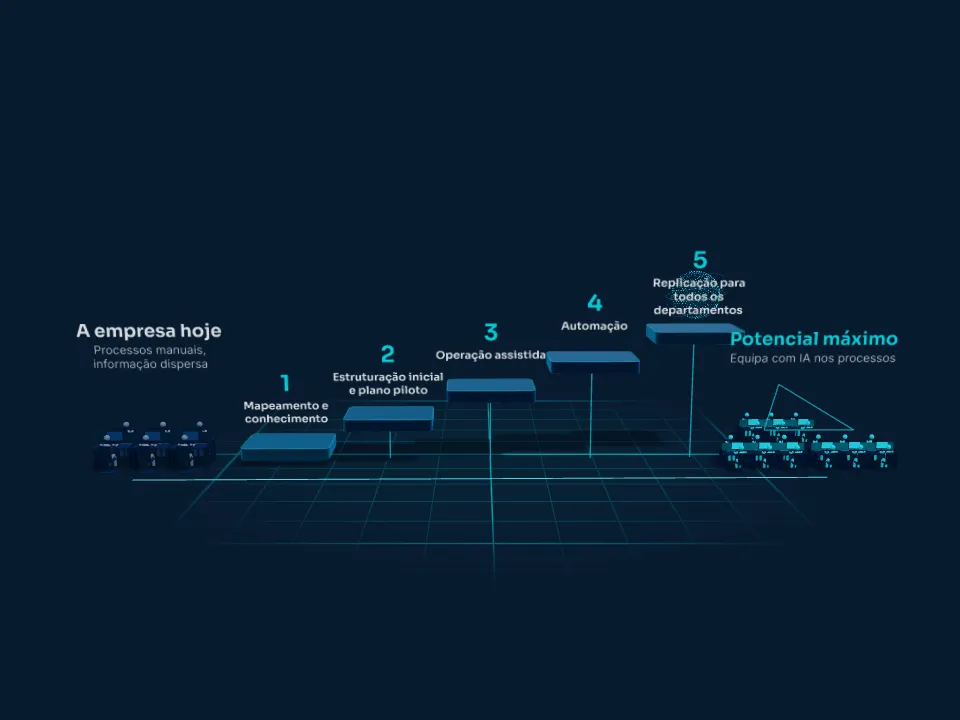
The AI transformation programme takes a company from informal AI use to redesigned processes, where AI carries out part of the work and the team checks it. There are five stages, from mapping to roll-out across every department. Each stage starts only when the previous one has shown measured results.
For owners and directors of SMEs and groups in Mozambique who want the same team to do more, starting with finance.
In many companies each person uses AI in their own way: an email here, a summary there. That brings isolated gains but does not change how the team works. The step change happens when the process is redesigned so that AI carries out a part of it, with prepared data, approved rules and a person checking. Without that, AI depends on each individual’s initiative.
In March 2026, Anthropic, the company that develops Claude, published a study comparing two measures across 22 occupational categories: the share of tasks AI can do in theory, and the share where use of Claude at work has already been observed.
94%of business and finance tasks are within reach of AI, in theory.
29%is the share where real use is already observed, in Claude usage data.
Swipe to see the whole chart.
In our experience, the gap closes one routine at a time: the company chooses where to start, redesigns the process around AI and trains the team to check the result. That is the work we do.
| Occupational category | Theoretical capability | Observed use |
|---|---|---|
| Management | 92% | 13% |
| Business and finance | 94% | 29% |
| Computer and maths | 94% | 33% |
| Architecture and engineering | 85% | 5% |
| Life and social sciences | 77% | 10% |
| Social services | 51% | 4% |
| Legal | 89% | 21% |
| Education and library | 62% | 18% |
| Arts and media | 84% | 19% |
| Healthcare practitioners | 60% | 4% |
| Healthcare support | 28% | 2% |
| Protective service | 31% | 2% |
| Food and serving | 16% | 1% |
| Grounds maintenance | 4% | 1% |
| Personal care | 18% | 1% |
| Sales | 62% | 26% |
| Office and admin | 90% | 34% |
| Agriculture | 15% | 1% |
| Construction | 17% | 1% |
| Installation and repair | 18% | 1% |
| Production | 19% | 1% |
| Transportation | 12% | 1% |
We start with meetings with the manager of each area, to understand the processes, the time they take and what the board wants to solve first. In parallel, an introductory course shows the team how AI works and what it can do in practice. This stage works as the AI diagnostic: the financial proposal comes only after it.
Together we choose one routine for the pilot and work through it in four steps.
The team starts running the routine day to day, with our support. We fix what comes up, refine the rules and make sure the process works without us.
What repeats and is already stable starts to run automatically, connected to the company’s systems. The team keeps the checking and the decisions.
With the method tested and the numbers in hand, we take the same work to the company’s other areas, one at a time.
We move to the next stage only when the numbers are in hand.
These eight routines are known uses of AI in finance. In each one, AI prepares the work and the team checks and decides.
| Task | How AI helps | Where human oversight sits |
|---|---|---|
| Month-end close | Collects schedules, checks totals, lists what is missing | The team approves every adjusting entry |
| Consolidation | Converts formats and aligns charts of accounts | The controller validates the account mapping |
| Variance analysis | Highlights variances and proposes questions | Owners explain; the board decides |
| Reconciliations | Makes the obvious matches | The team handles the exceptions |
| Treasury | Updates the forecast with known data | The treasurer reviews the assumptions |
| Pay and collect | Classifies invoices and prepares follow-ups | Payments and messages go out only once approved |
| Tax and audit | Organises files and checklists | The team and tax advisers sign off |
| Reporting | Writes the draft commentary | The finance director reviews and signs |
Independent condominium administration in Maputo, operated on myCONDO.
What TRBusiness did: ERP and accounting automation.

Digital solutions for the financial sector.
What TRBusiness did: Automation of invoicing, collections and accounting tasks.

TRBusiness was founded by Igor Mosquini Bastos, an economist with an MBA in Finance. He personally leads the AI diagnostics and the transformation programmes.
The programme always starts with the AI diagnostic, carried out with the board and the manager of each area. At the end you receive three things:
We start with fictitious or sample data. Real data enters only with business accounts of the AI tools, which do not train models on your data, with minimal access to the folders needed and a signed confidentiality agreement. The access rules are written into the pilot plan before the work begins.
Sometimes a redesigned process needs more than AI. In those cases we build and connect what is missing, within the programme and only when the process calls for it.
It starts with the AI diagnostic, in stage 1. We meet the manager of each area to understand what they do, how long it takes and what the board wants to solve first. In parallel, the team takes an introductory course. Only after that do we choose the pilot routine and present the financial proposal.
It depends on the number of areas and on the routine chosen for the pilot. The first stage is short, so it does not tie up the team. The pilot uses data from a month already closed, so results arrive quickly. The timetable for each stage is in the plan approved before we start.
You do not need to start with everything in order. Organising the data and the rules is part of the work in stage 2. What we need is access to the files and to the people who know the process. If the data is very scattered, that shows up in the mapping and goes into the plan.
No. AI carries out the repetitive part of the work, and the team checks, corrects and decides. The aim is for the same team to do more and spend more time analysing than gathering data. Every routine has a human checkpoint before the result goes out.
Internal control stays in place and becomes more visible. Each new routine has defined checkpoints, an owner for every approval and a record of what was done. AI does not approve entries or payments: it prepares the work for whoever approves. Segregation of duties stays exactly as your company defines it.
Yes, and that is usually where the gain is largest, because consolidation and reporting across several entities take a lot of time. Each company keeps its own indicators; AI combines, compares and explains, without flattening what is different. The group finance team still decides how entities are presented and which differences matter.
No. AI works with the files and exports your accounting system already produces, so the team keeps its current software, chart of accounts and habits. If it later makes sense to connect a routine directly to the system, that belongs in the automation stage of the programme, after the routine has proved itself.
We work mainly with Claude, from Anthropic, because it is the model we know best in financial work. We have no affiliation with Anthropic. The method works with other models, and the final choice depends on your company’s tools and rules.
In a few meetings we understand your processes and the board’s priorities. The proposal comes afterwards, with your own company’s numbers.
Last updated: 18 November 2026